 |
|
|
Photo of the Webmaster sitting
on
an A-7 Corsair II.
Inside the A-7's cockpit you can see the ejection seat handle.
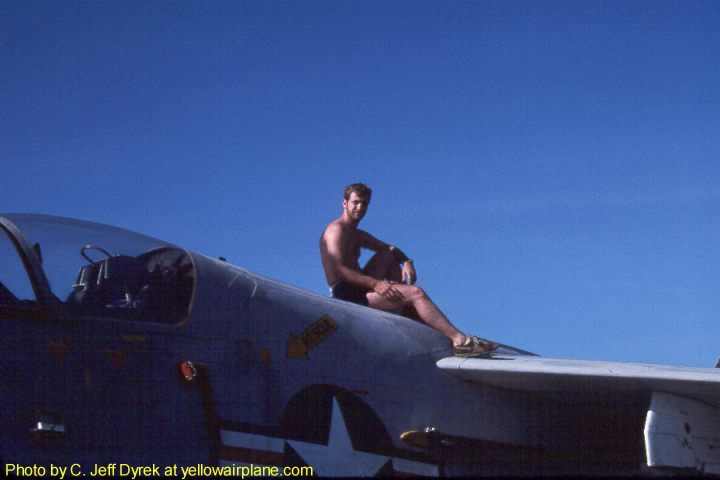

Photo by C. Jeff Dyrek
Look inside the canopy. You can see a loop at the top of the ejection seat.This is the primary ejection seat handle. The pilot pulls this handle to activate the ejection sequence. However, there's a lot more to ejecting from an airplane than just pulling the handle and shooting out of the airplane. When you pull the handle just 1/4 of an inch, the sequence begins and cannot be stopped. First a canopy breaker, two arms attached to each side of the upper part of the seat, pop up and breaks the canopy loose from its frame. By this time the pilot has the face curtain which is attached to the ejection seat handle, over his face.0009789ALT="A-7 Corsair II 1/72 Plastic Model Kit" HSPACE=10 VSPACE=10 BORDER=2 height=105 width=250 align=RIGHT>Next the solid rocket motor fires. It's not a rocket like you see on TV where the rocket gently lifts the pilot off of the ground. This rocket acts more like a cannon shell exploding under the ejection seat. The pilot is ejected very, very fast. As the rocket blast pushes the ejection seat out of the plane, the tremendous G force causes the pilots hands and the face curtain to be pulled into his lap. The face curtain, flight suit and seat frame are very important. If a pilot ejected at 600 mph without these protective devices, the tremendous force of the wind at that speed would first break both of the pilots arms, his legs, his neck and his back. His body would then receive third degree burns by the tremendous oxidizing effects of the wind. He would not have a good day. Back to the ejection seat firing sequence. Before the pilot can eject, he must have previously set up his seat and rudder pedals to the proper position. These jets are like a fancy car with electric seats, you hit the button and the seat moves up and down. This is not designed primarily for comfort but for the pilots safety. He must move the seat and rudder pedals to a position where he cannot put his fingers under his leg. If the had the space of just the thickness his fingers between the seat and his leg when he pulled the ejection handle, the ejection force would break both his legs just above his knees. Many times upon ejection a pilot will break something anyway, his arm or his leg. Ejection seats are a last resort, only. When I went through ejection seat training, I had to do this for a back seat license in the TA-4, we watched many videos on the ejection process. Just like on TV, you see the guy fly out of the aircraft neat and easy. But when they showed the process at normal speeds it looked more like something out a comedy program. The pilots shot out of the airplane at a tremendous speed way faster than what looks real. The films you see in the movies are slowed down to make the ejection process look real. I heard that the slowed down Bruce Lee's kicks to make them look real also. One more thing. There is another handle on the seat between the pilots legs. This is also an ejection handle. The pilot may pull this one if he doesn't have time to reach the handle above his head. The bad part of pulling this handle is that he eliminates the face curtain protection that the upper handle provides against the horrendous wind. The Russian's
had an additional solution for aircraft ejection's performed at near and
above mach one.
They place an air deflection device between
the pilots feet.
When the pilot ejected,
although very small,
this device would block the air hitting the pilot providing added safety
against the air blast.
From: Ken and Annette Cooke. Subject: FW: Who Packs Your Parachute? Charles Plumb was a U.S. Navy jet pilot in Vietnam. After 75 combat missions, his plane was destroyed by a surface-to-air missile. Plumb ejected and parachuted into enemy hands. He was captured and spent 6 years in a communist Vietnamese prison. He survived the ordeal and now lectures on lessons learned from that experience. One day, when Plumb and his wife were sitting in a restaurant, a man at another table came up and said, "You're Plumb! You flew jet fighters in Vietnam from the aircraft carrier Kitty Hawk. You were shot down!" "How in the world did you know that?" asked Plumb. "I packed your parachute," the man replied. Plumb gasped in surprise and gratitude. The man pumped his hand and said, "I guess it worked!" Plumb assured him, "It sure did. If your chute hadn't worked, I wouldn't be here today." Plumb couldn't sleep that night, thinking about that man. Plumb says, "I kept wondering what he might have looked like in a Navy uniform: a white hat, a bib in the back, and bell-bottom trousers. I wonder how many times I might have seen him and not even said 'Good morning, how are you?' or anything because, you see, I was a fighter pilot and he was just a sailor." Plumb thought of the many hours the sailor had spent on a long wooden table in the bowels of the ship, carefully weaving the shrouds and folding the silks of each chute, holding in his hands each time the fate of someone he didn't know. Now, Plumb asks
his audience, "Who's packing your parachute?"
|
<<<
Previous Photo
Next Photo >>>
|
Look at these other USS Kitty Hawk Exhibits. |
|||
| Home | Many More Exhibits Here | Dan Collier | Darren Drake |
| Jeff Dyrek 77-78 | Howard Freeman | Brad Jones | Morgan |
| 34th Fighter Squadron | 413th Fighter Group | Famous People | Model Ships |
| Art | Books | Model Airplanes | |
| Videos | |||
| Video Games | |||

|
|
To See All
Exhibits in the Yellow Airplane Museum, Click Here.
Yellow
Airplane Home Base
 Airplane
Books
*
Airplane
Movies
*
*
Airplane
Models
*
Camaros for SaleAircraft
Calendars
*
Jet
Fighter Models
*
Flight
Manuals Exhibits
* Museums
*
RC
Boats
*
Ship
Models
*
Sailing
Ships
Tanks
*
Military
Vehicles
*
Airplane
Books
*
Airplane
Movies
*
*
Airplane
Models
*
Camaros for SaleAircraft
Calendars
*
Jet
Fighter Models
*
Flight
Manuals Exhibits
* Museums
*
RC
Boats
*
Ship
Models
*
Sailing
Ships
Tanks
*
Military
Vehicles
*
*
*
Action
Figures
*
Train
Sets
*
Railroad
Books
*
Real Sports Cars for Sale
*
;
Real Sports Cars for
Sale
*
Adventures
*
Survival Equipment
More Aviation Art
*
More Models
*

