|
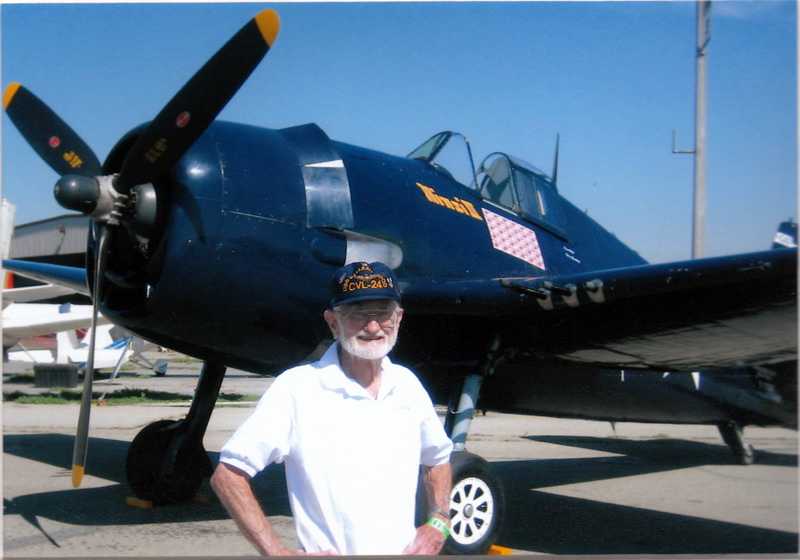
Mayer, Irving March 28 1920 - December 29, 2011 Irving was born in San
Francisco to Max and Lena Mayer. He graduated with a B.S. from UC Berkeley in
Electrical Engineering and a M.S. in Business Management. Irving was a decorated
Navy fighter pilot in WWII, serving on the U.S.S. Santee, CVE- 29 and the U.S.S.
Belleau Wood, CVL-24. After the war, he worked in Systems Management for major
aerospace companies in Southern California. He was preceded in death by his
first wife, Winifred, and his son, Michael. Irving will be lovingly remembered
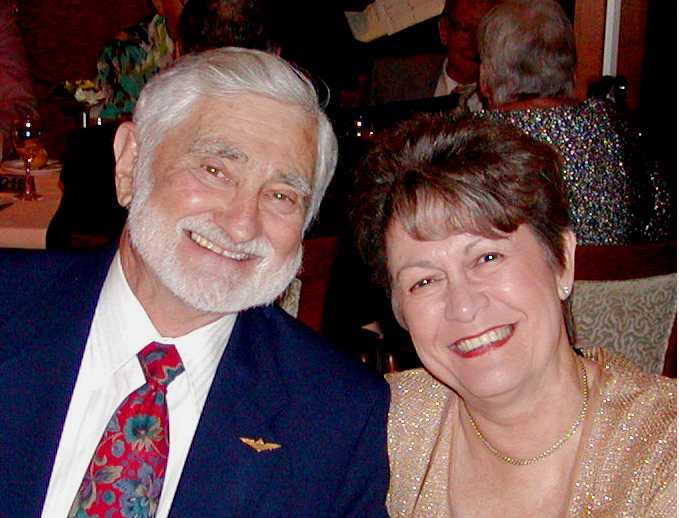
by his many friends and family. He is survived by his wife, Linda Mayer;
brother, Bert Mayer; sister, Sandy Mayer; daughter, Carole Morgenstern;
stepdaughter, Sheri Henderson; and two grandchildren, Zachary Mayer and Zoe
Morgenstern. From the Webmaster: It was a big
blow to me to hear that Irving had passed away. I was an internet friend
of his for many years and we would talk on the phone very often. At 89
years old he would still remember the angle of dive that he was on and the angle
of the shadows of the trees as he made diving runs at Japanese machine guns with
his F6F Hellcat Fighter Plane.
One day I asked him if he has ever seen a Japanese
Ki-61 Hein (Tony) airplane. The plane had the planform, overhead view,
very similar to the P-51 and was a very powerful airplane made by the Japanese.
Irving told me about how he was flying over an island in the western Pacific and
he looked down and saw what looked like a P-51 Mustang flying low below him.
He called back to the Combat Information Center and asked them if there were any
P-51s in this area and they replied with a firm NO. So Irving rolled the
plane upside down and came into a dive and shot the plane down. He later
found out that it was indeed a P-51 and the pilot got out without being hurt.
Irving also told me about going head to head with a
Japanese airplane in a dogfight. He told me about how how he was flying
his F6F Hellcat, predecessor to the F4F Wildcat, but much more powerful, when he
met up with the Japanese pilot. They both went into a vertical climb,
standard tactics for a Zero against the F4F, and the Japanese pilot was
surprised to find that his plane went into a stall before the F6F. Irving
then pointed his plane right back down to the Japanese plane and shot it down.
Irving explained to me that since the F6F was new and the fact that it looked
very much like the F4F that the Japanese pilot was using the successful tactics
against the F4F and not Irving's F6F Hellcat. The damage was done and the
Japanese pilot lost.
About six years ago I had a real nice 1/15 Scale F6F
Hellcat model and I sent it to Irving. He was very pleased to receive it
and told me that it had the markings of his best friends name. I am sorry
that I did not remember his friends name. It was almost like fate that I
sent him his best friends airplane.
At 89 Irving sounded as sharp as a twenty five year
old soldier. He was bright and sharp and he looked more physically fit
than me. For two years, I was very ill and didn't have a chance to talk to
Irving. Then when I finally called in February of 2012, his wife told me
that he had passed away. Irving was my friend and I miss him very much.
C. Jeff Dyrek, Webmaster. |