|
The Flight
of the Hog Wild
Полёт
“Дикого
Зверя”
Bill Streifer
Irek
Darvishevich Sabitov
“The Circumstances of the case give me the greatest
anxiety…”
General Douglas MacArthur
Sept. 4, 1945
An
Introduction
“The more I read of your research, the stranger the
whole affair becomes. Some of your work is bringing back
memories and questions I had at the time but dismissed as
contemporary events, overwhelmed my attention”
Tech Sgt. Arthur Strilky
Hog Wild’s Radio Operator
|
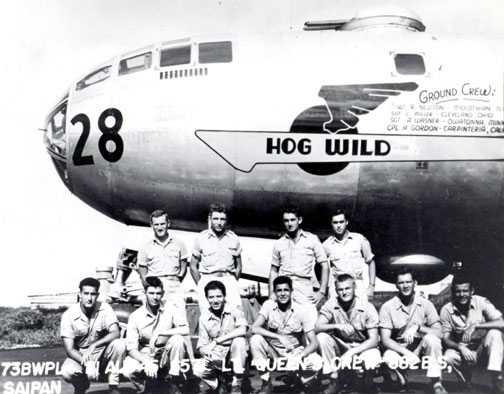
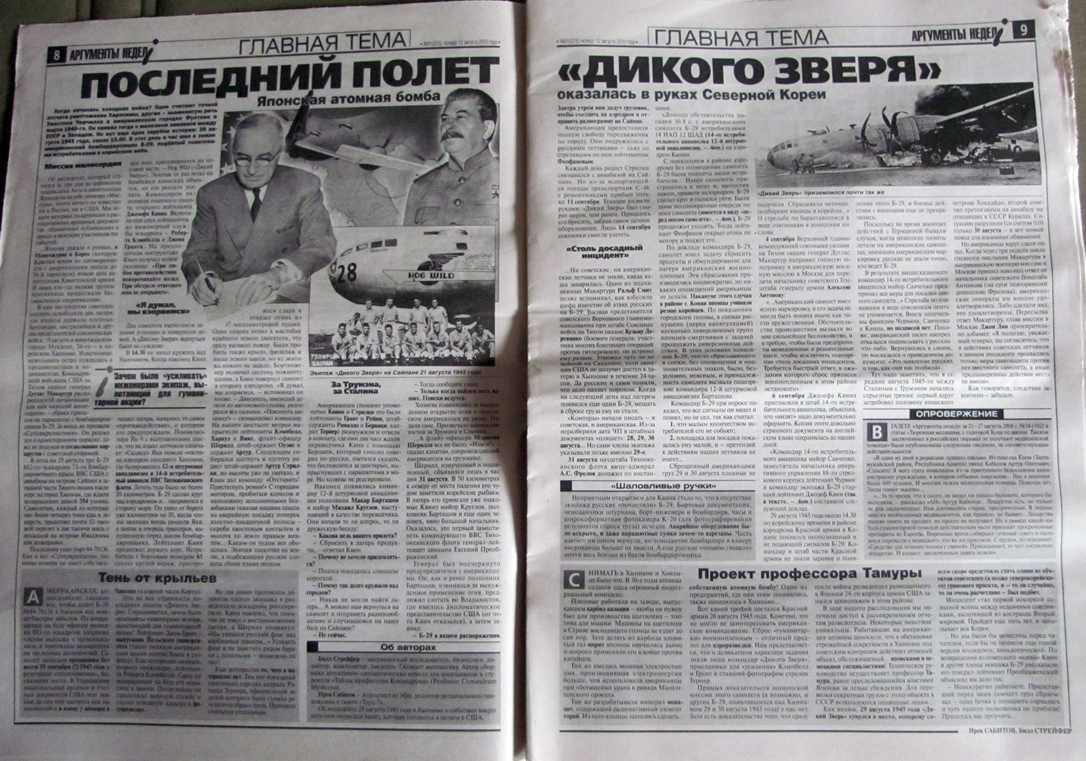
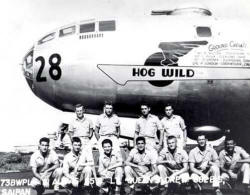
This a photo of the Hog Wild and its original crew, although (suspiciously) at least four of the regular crewman were replaced by squadron level officers for this mission. Although the airplane commander, pilot, navigator, Arthur Strilky, and others are in the photo... its not the crew of the 13 that were shot down by the Soviets. |
On
August 29, 1945 , on the very day that General Douglas
MacArthur became Supreme Commander of Allied Forces after
the Japanese had surrendered, and coincidently on the day
known by Koreans as a “day of national shame,” the U.S. sent
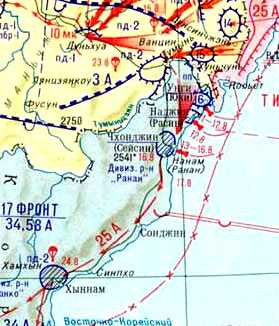
a B-29 called the Hog Wild on a mission to Konan in
northern Korea , a city now known as Hungnam .
Under
the guise of a “mercy mission” to a former Japanese POW
camp, now under the control of the Soviet Union , three
B-29s with supplies for 600 men were sent to the North
Korean camp
believed to house only 156 British and Australian prisoners.
It is
becoming apparent that the true mission of the third B-29 to
arrive at Konan, Korea that day was not as it appeared or had
pretended to be. In actuality, the Hog Wild was on a
photo recon mission over an area of Korea which the American
military had never seen before
The
Airplane Commander, Lieut. Joseph Queen, was under strict
orders to “forget dropping supplies and return to Iwo Jima
if the plane encountered trouble.” As he was soon to
discover, “trouble” was an understatement.
|
|
While
the Hog Wild suspiciously circled over the Korean POW camp
once too many times, four Russian Yak fighters were sent up
to force the B-29 to land. According to a Soviet report, one
of the Russian pilots, “on his own initiative” began firing
on the B-29, causing engine #1 to burn fiercely. The B-29
engine, made partly of light-weight magnesium, could not be
extinguished by the automatic fire-extinguishing system on
board and, despite their best efforts, a ferocious fire
continued to burn out of control. |
Seven
members of the crew were instructed to remain in the plane
as it crash landed - badly damaged and afire - on a Russian
airfield in nearby HamHung, after six others had bailed out
into the cold, Sea of Japan , also known as Korea ’s East
Sea . Despite extensive damage and an engine on fire, 1st
Lieut. Joseph Queen managed to land the B-29 safely, and,
despite a published report to the contrary, not a single
crewman died.The Hog Wild, built in June 1945, was a late-model
“Superfortress,” equipped with the most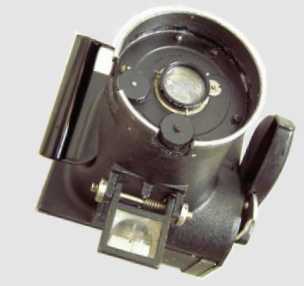 sophisticated radar
system available, and a portable, large-format,
high-precision “aerial reconnaissance” K-20 camera which the
Soviets had never acquired through lend-lease. sophisticated radar
system available, and a portable, large-format,
high-precision “aerial reconnaissance” K-20 camera which the
Soviets had never acquired through lend-lease.
The true
mission of the Hog Wild (with an irregular crew,
including four, squadron-level officers) may never be
discovered, however, in the opinion of Lieut. Col. Earl J.
McGill (USAF Ret.), the Hog Wild was a “spook,” a spy
plane whose mission was known by a select few. If
interrogated, the crew would repeat their “mercy mission”
cover story, and any accusation of spying or
photoreconnaissance would be denied.
According to Professor Cumings of the University of Chicago
, a Korean history expert, spy missions over North Korea
prior to the Korean War were not uncommon. The Hog Wild
may simply have been one of the earliest. In any event, the
members of the Hog Wild crew were the only American
military personnel to have set foot in the area for decades,
In
late-August 1945, there had been no written agreement
between the United States and the Soviet Union to divide
Korea into two halves, only an understanding between the
parties. General MacArthur’s General Order #1 of August 15,
1945 unilaterally decreed that the Soviets would control the
north half of the Korean peninsula above the 38th parallel,
and the United States would control the southern half. “The
Soviets never publicly agreed to it, never signed anything…
they just agreed to it de facto.” In early August, a Soviet
communiqu prohibited firing on American aircraft, but by
late August, that ban had been lifted.
So
technically, an invasion of Soviet airspace by the Hog
Wild on August 29, 1945 was not a violation of any
agreement since no agreement existed. Rather, it was General
MacArthur asserting his authority as Supreme Commander.
On Sept.
4, 1945 , MacArthur sent a cable to the Soviet High Command
expressing, in no uncertain terms, his outrage at the Soviet
downing of an American plane. If MacArthur had not done so,
this incident may very well have faded into history, and if
the Soviets had not replied immediately with an apology, the
incident may have become into an international incident.
MacArthur’s cable (which we now know contained a number of
errors) read as follows,
“On August 28 at Kanko (HamHung),
Korea , a United States B-29 of the 75BW, while engaged in
dropping supplies to prisoner of war camps at Chosen Branch:
30 deg 53 min N 127 deg 38 min E was shot down by Russian
fighters. The American plane was plainly market and its
mission could not fail to have been identified as purely
benevolent. The circumstances of the case cause me the
gravest anxiety and I request that immediate and decisive
steps be taken to prevent a reoccurrence of so deplorable an
incident. A prompt reply is requested pending which the much
needed dropping of supplies to prisoners of war in this area
had been stopped.”
On September 16, Supreme Headquarters (headed by
MacArthur) announced that the Soviets had “officially
apologized” for the downing of the Hog Wild.
 Once the
Hog Wild crew had satisfactorily explained the
situation to Soviet commanders, they were permitted to roam
freely within the former-Japanese POW camp and throughout
the surrounding city. They met Russian pilots and officers,
Korean doctors and a professor, as well as British and
Australian POWs, many of whom they befriended. This
permitted them to make discoveries which, until now, have
remained buried in secret Army documents for over sixty
years. Once the
Hog Wild crew had satisfactorily explained the
situation to Soviet commanders, they were permitted to roam
freely within the former-Japanese POW camp and throughout
the surrounding city. They met Russian pilots and officers,
Korean doctors and a professor, as well as British and
Australian POWs, many of whom they befriended. This
permitted them to make discoveries which, until now, have
remained buried in secret Army documents for over sixty
years.
Through
a discussion with a Korean professor - a student of Albert
Einstein -- they discovered why North Koreans had accepted
Communism so readily and why the plan to divide Korea into
North and South would not work, and would inevitably lead to
a “civil war.”
They
discovered that Soviet fighters were made of wood, and that
British POWs were forced to manufacture the “precursor” of
chemical weapons under inhumane conditions, the manufacture
of which some believe are still being carried out today in
North Korea.
Despite
theB-29’s sophisticated radar system and a crew capable of
operating it, the Russians bought the American version of
the story that they were simply unable to locate a POW camp
due to bad weather and deficient maps. Once high-ranking
Soviet officers and flight engineers, who refused to believe
that the B-29 had been shot down, accepted the Hog Wild’s
“cover story” of a POW mission gone bad, the crew were
permitted to return to their plane and radio for assistance.
One
explanation, is that Russian commanders naively accepted
Queen’s explanation, and permitted the thirteen-man crew to
roam freely about, eventually becoming friends of sort,
sharing food, drink, dance and song. At one point, they were
offered free passage home through the Soviet Union , which
they graciously declined after being forewarned by a Russian
pilot that by doing so they may be placing their lives in
jeopardy.
A more
plausible explanation is that the Russians suspected the
true mission of the Hog Wild, but when General MacArthur
sent the cable to the Soviet High Command warning them that
their actions were unacceptable, the Russians were in a
bind. Not returning the crew could have resulted in an
international “Cold War” incident like the U-2
spy plane
downing over the Soviet Union some fifteen years later.
Still,
the similarities between the New York Times reporting of the
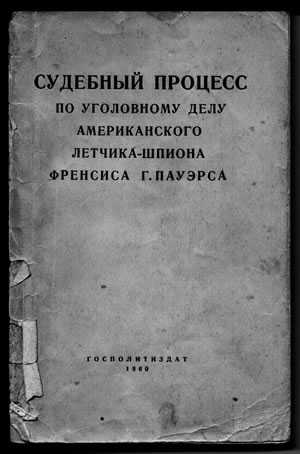
Hog Wild (1945) and Gary Powers’ U-2 (1960) incidents
are intriguing. With respect to the U-2 incident, the Times
wrote, “Soviet Downs American Plane; U.S. Says it was
Weather Craft” And in 1945, the Times wrote, “Four Russian
fighter planes shot down an American B-29 which was on a
mercy mission…”
According to David Snell, a future LIFE Magazine
investigative reporter, the Russians had secretly occupied a
nearby Japanese nuclear facility, kidnapped and tortured six
nuclear scientists inside, and returned the scientists to
Moscow . By befriending the crew, retrieving the K-20 camera
on board (and the photos that may have been taken), and
permitting the safe return of the Hog Wild crew into
American hands, perhaps the Russians mistakenly believed
that the incident might quickly go away, and be forgotten.
But now, for the first time,
suspicions of nuclear and chemical weapons facilities in
North Korea , as far back as 1945, can now be supported.
One day, perhaps, the true identity of the Japanese
“counter-intelligence” officer Snell interviewed, the names
of the six, Japanese nuclear scientists supposedly captured
and tortured by the Russians, and the full text of the
interview by Cecil Nist (head of G-2 Army Intelligence, XXIV
Corps) of the Hog Wild crew may be revealed.
By the
end of WWII, the Americans had the atomic bomb and a plane
capable of delivering it to its target, and the Soviets had
neither. Stalin had seen, with his own eyes, how the
Americans had used B-29s to drop atomic bombs with great
success on Hiroshima and Nagasaki , just a few weeks
earlier.
According to Sergei Khrushchev, the son of Premier Nikita
Khrushchev, after the success of the B-29 called the Enola
Gay, Stalin’s interest in acquiring an American strategic
bomber was renewed. Stalin’s written order, dated June 1945,
confirms this. The United States possessed the B-29
“Superfortress,” the greatest bomber in history, and yet was
quite unwilling to share it with the Soviet Union .
What
began as a scholarly analysis of a military confrontation
between the United States and the Soviet Union on August 29,
1945 in northern Korea during peacetime has evolved, quite
unintentionally and unexpectedly, into significantly more.
This is a unique examination of American-Soviet relations,
Japanese-Korean relations, Stalin’s attempt to acquire
Japanese nuclear and chemical weapons technology, as well as
a Soviet nuclear delivery system. And - for the first time -
a look at the infancy of North Korea’s chemical and nuclear
weapons programs, as seen through the eyes of thirteen
American airmen and three British POWs. It may also shed new
light on one or more top-secret missions during the Korean
War.
It is
not surprising to what extent the U.S. Army and Air Force
has gone to bury this incident in history. When Eugene
Harwood, the Hog Wild’s navigator, was asked during an
unaired interview by Iowa Public Television, if he had been
a POW himself, he responded “in a manner of speaking.” When
I asked the same question of Arthur Strilky, the Hog
Wild’s radio operator, I received a similar response
with the additional caveat, “I never knew why the Russians
shot us down.” Perhaps the POW camp where Queen, Harwood,
Strilky and the others were interned for eighteen days was
intentionally misidentified by the Army Air Corps as being,
not in extreme North Korea but rather, in South Korea - near
Seoul .
When the
Air Force was asked what had become of the plane, they
responded, “It appears that the aircraft was lost as missing
after a collision on 19 Sept 1945 ,” when in fact there had
never been a collision. In reality, the Hog Wild and
its top-secret components were examined by a Soviet B-29
expert, on the ground in Korea . Their intention was to use
the information they acquired to created the Soviet version
of the B-29 called the Tupolev Tu-4, through a process
called “reverse engineering.”
While
most experts believe that the process had begun in 1944 when
the Russians acquired the Ramp Tramp and other B-29s, the
reality is that all B-29s acquired by the Soviets had been
fired upon, and serious development of the Tu-4, according
to a Soviet publication, didn’t begin until early 1946 -
long after the downing of the Hog Wild.
Although
Army Air Corps protocol requires that a Missing Air Crew
Report (MACR) be filed after two days, none was filed for
the Hog Wild, perhaps believing that would end an
inquiry into the plane’s fate. But the military had failed
to destroy the Hog Wild crew’s detailed account of
the incident, the press reporting of an Air Force news
briefing, and other documents. Perhaps now they will wish
they had done so.
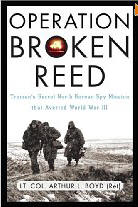
And for those who find a spy
mission during the summer of 1945 unlikely - a mission
which has remained a tightly-held secret for so long - a
possible explanation is provided
by Jay T. Young in the “afterword” of Arthur Boyd’s book,
Operation Broken Reed. “Since
North Korea remains a potential adversary of the United
States, and one with a growing inventory of missile-delivery
systems, large stocks of chemical and possibly biological
weapons, and perhaps a small nuclear arsenal, Washington may
still be reluctant to release details about how much and
what kind of intelligence it obtained on North Korea and its
Chinese and Soviet allies in the past.” And according to
Lieut. Col. Boyd, the Army had used the “fake” downing of a
B-29 and crew to infiltrate North Korea
during the Korean War.
Operation Broken Reed: Trumans Secret North Korean Spy Mission That Averted World War III

|
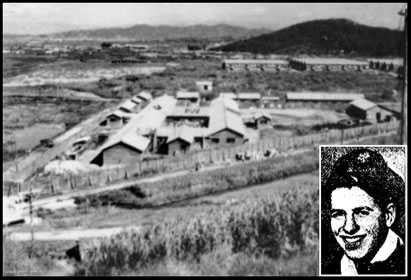
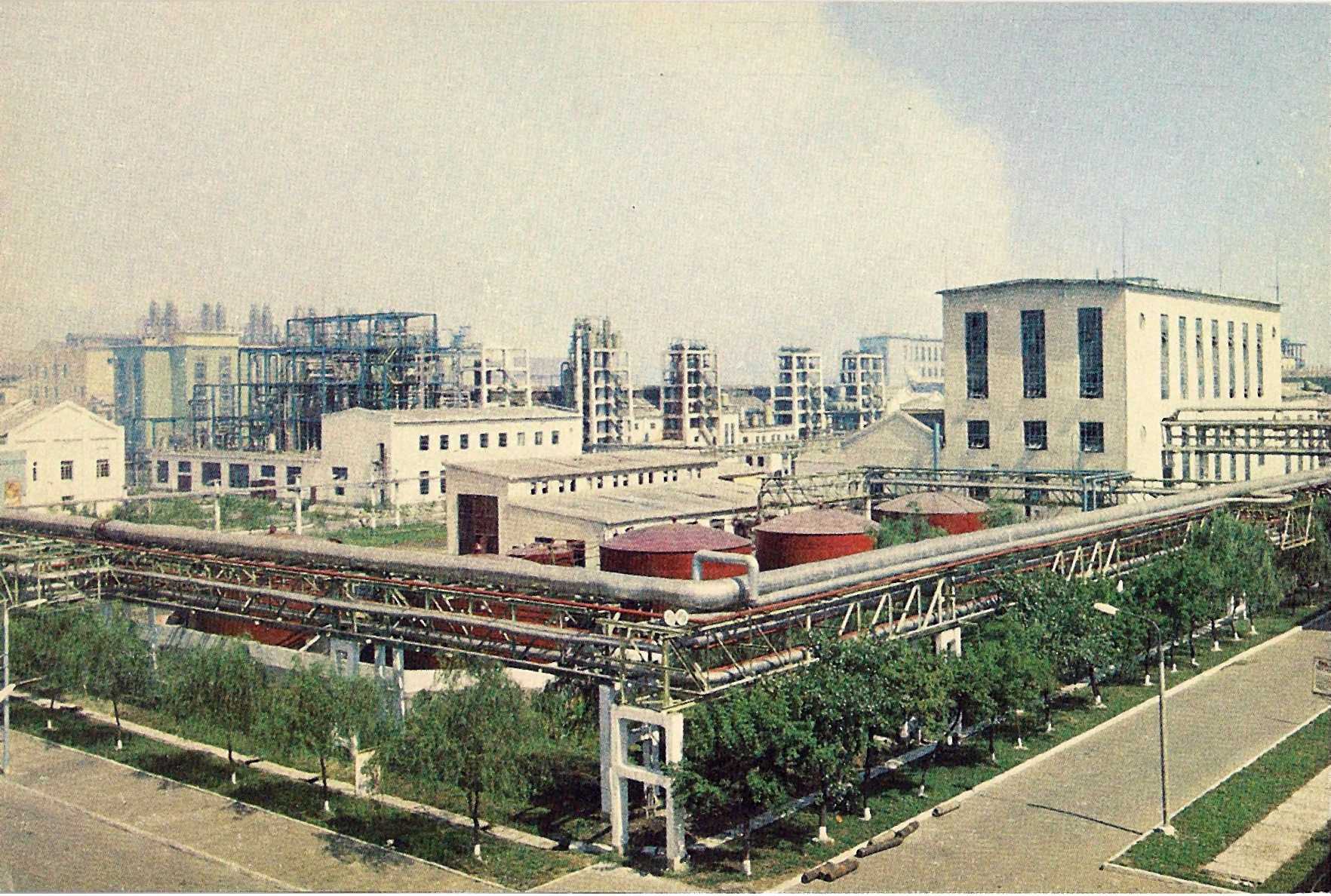
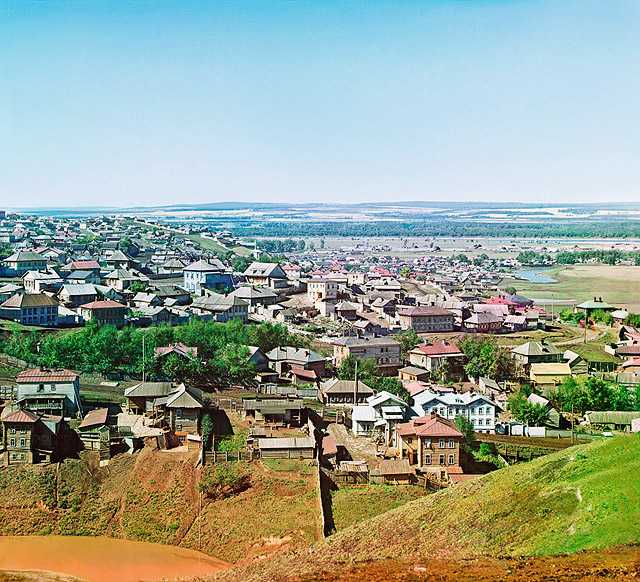
This is a
rare photo of the Konan POW camp, where
the American B-29 crew was interned for 18 days.
(They were, most likely, the first Americans to
ever set foot in (North) Korea until the
Korean War (1950). The picture was taken
in Sept. 1945 (when the B-29 crew was there!).
The inset (from a Sept. 1945 newspaper article)
is of Arthur Strilky, the Hog Wilds radio
operator. Strilky (then 19) is now 83. He is the
last surviving crew member of the Hog Wilds
final mission. I interviewed him in depth for
the book. Can you believe he drives a sports car
and races sailboats at 83?? |
|


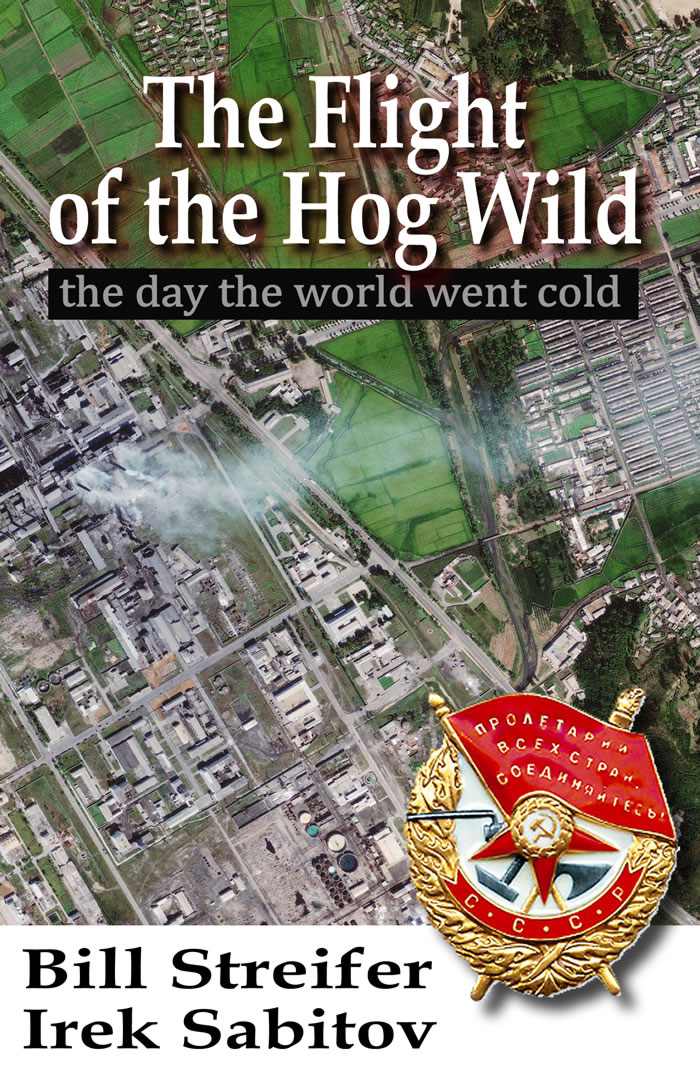
 Bill Streifer is currently writing a biography of the
investigative reporter David Snell, entitled Plausible
Deniability. Born in northern Louisiana , Snell was drafted two
weeks prior to V-J Day, assigned to the Criminal Investigation
Detachment (CID) of the XXIV Corps, and stationed in Korea . He
began his career as a reporter for a small Louisiana newspaper. He
later wrote for the Atlanta Constitution, the New York
World-Telegram & Sun, and eventually became a Senior Editor for LIFE
Magazine during the heart of the Cold War. On Oct. 3, 1947 , David
Snell wrote the first newspaper account of the downing of the Hog
Wild to spark national attention.
Bill Streifer is currently writing a biography of the
investigative reporter David Snell, entitled Plausible
Deniability. Born in northern Louisiana , Snell was drafted two
weeks prior to V-J Day, assigned to the Criminal Investigation
Detachment (CID) of the XXIV Corps, and stationed in Korea . He
began his career as a reporter for a small Louisiana newspaper. He
later wrote for the Atlanta Constitution, the New York
World-Telegram & Sun, and eventually became a Senior Editor for LIFE
Magazine during the heart of the Cold War. On Oct. 3, 1947 , David
Snell wrote the first newspaper account of the downing of the Hog
Wild to spark national attention.