The
Kitty Hawk by ET2 Darren Drake |
|
The F-18 Hornet Click Here's a picture of a Super F-18 Hornet breaking the sound barrier. The sound barrier varies with altitude but is mostly dependent on the temperature. The higher you go, the colder it is and the air is also thinner. If you travel entirely into space, there is no air and sound cannot propagate, so there is no sound in space. Click here to see pictures of he kitty hawk back in 1977 Click here to go to the Yellow Airplane Home Base |

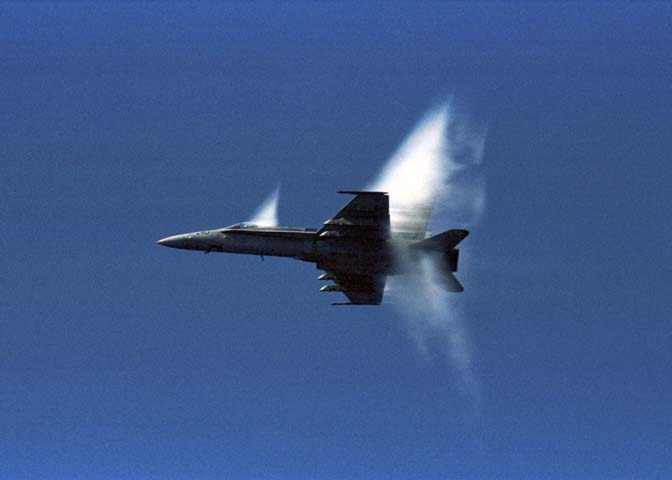 |

Photo from ET2 Darren Drake
stationed aboard the USS Kitty Hawk
Click here for a fantastic video of an F-14 Tomcat breaking the sound barrier next to the USS Kitty Hawk,by Darren Drake |
|
The f18 shown in this picture is the only VA-192 airplane with the beautiful colors on its tail. This is the public relations version. The other hornets are all misty grey for better camouflage Click Here's the best explanation for the boom.about sonic booms. The "boom" actually DOES NOT happen when the airplane exceeds the speed of sound. Some people imagine that the speed of sound is a "barrier", and that a sonic boom is the noise made when this barrier is "broken." This isn't correct. Here's an analogy which might make things clearer. A normal airplane is like a rowboat making waves in a smooth lake. A supersonic jet is like a speedboat which leaves a V-shaped wake behind it as it travels. Imagine a rowboat on a lake. Imagine that you are viewing it from above. It is moving forward. It is also making waves as the boat jumps ahead and as the paddles disturb the surface of the water. These waves move much faster than the boat, so what you'll see from above is a slowly moving boat with a bulls eye-pattern of waves expanding from it in all directions. A normal airplane is like our boat, and the sound waves are like the waves on the water. As an airplane moves ahead, it sends out sound waves in all directions. The waves travel faster than the plane. The sound waves are like spherical onion-layers which fly outwards from the plane, with the airplane in the center of the expanding "onion." If a speedboat travels faster than the speed
of water waves, it cannot send out a bulls eye-shaped pattern of ripples.
For every ripple it made, the speedboat would plough forward through the
ripple, moving faster than the ripple possibly could. Because it oversteps
its own ripples, a speedboat instead makes a V-shaped wake on the lake.
This wake is like a sonic boom, but it's using water waves rather than
sound waves.
Pilots cannot hear their own sonic boom. If
you were Superman and could fly along outside a supersonic aircraft, you
would not hear the boom either. This is because for you the "boom" is a
region of increased pressure
that follows along with the plane. Superman
could stick his hand into the airplane's
one-shaped wake and feel
the high pressure there. He could even stick his head into the pressure
wake but still would hear no "boom" (although the pressure change might
make his ears pop!) A sonic boom is only a "boom" or "crack" sound for
people on the ground. As the plane flies along, it drags its cone-shaped
pressure wave along the ground like a skirt. As the cone of pressure passes
by, we hear it as an explosion. It's very much like the sound-pulse from
an explosion, but rather than expanding from a centralized explosion, the
wave is being continuously created by the flying plane. Depending on the
shape of the plane and its speed, the pressure wave might be thick or thin.
If it's thin, it will
sound like a "snap" or a "bang". If its broad,
it will sound like a "thump"
or a "boom." Imagine the wave from our
speedboat. As the boat passes by, all is quiet on the shore. The wave approaches,
then SPLASH!
ET2 Darren Drake
|
 |
Home |
 |
tokyo, tokyo bay, Tokyo, Tokyo Bay, kitty hawk, uss kitty hawk, aircraft carriers, aircraft carrier, carriers, carrier, navy, ships
|
F-18 Hornet 1/48 Die Cast
|
Aviation
Books
|

|
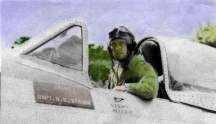
The 34th Fighter Squadron fly's a WW2 P-47 Thunderbolt Click on photo to see exhibit |
 |

| ||
|
Avitop.com Aviation banner exchange - Join now!
|
|


/WebSite/pics/Viewers_Pages/Drake_18.html|51477"
| . |