| North
Pole Action Adventures Home Page
Balloon Rally
at the North Pole
Skydiving at the
North Pole
Ski Tours on the
North Pole
Contact Us
Home page for Polar
Adventure Exhibits.
2005 North Pole Exhibit.
2005
North Pole Picture Gallery.
2003 North Pole Exhibit.
2003
North Pole Picture Gallery.
2002 North Pole Exhibit.
2002
North Pole Picture Gallery.
2001 North
Pole Exhibit.
2001 North Pole
Picture Gallery.
Curtis Lieber's South Pole
Action Adventure. Check
out this Video of the Yamal Cruise to the Pole. Lo Resolution for Web
use. |
Action ADVENTURE
TRAVEL
IS ABOUT
REACHING The EXOTIC PLACES ON EARTH,
YOUR MIND
BECKONS YOU TO.....
COME JOIN US...........
ADVENTURE
TRAVEL
The 2
Most Powerful Icebreakers in the WORLD
North
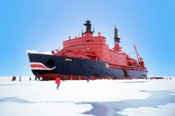
Pole aboard the Russian Ice Breaker YAMAL
 It
is perhaps the most amazing location on our entire planet. There are no
four corners of the World there: the South is all around you and any wind
is southern. Over this “Top of the World” stars never rise or set together
with the Earth’s rotation. The Polar Star, the beacon of all travelers
in the Northern Hemisphere, is invariably in its zenith. It
is perhaps the most amazing location on our entire planet. There are no
four corners of the World there: the South is all around you and any wind
is southern. Over this “Top of the World” stars never rise or set together
with the Earth’s rotation. The Polar Star, the beacon of all travelers
in the Northern Hemisphere, is invariably in its zenith. Click Here for more information
Click Here for a nice Yamal Video |
It is a cruise travel vessel
of 23,000 tons displacement and 75,000
h.p. capacity, with a hull thickness of 48
mm, is one of the most powerful and sophisticated ships in the
world. Designed as a working ship for plowing Russia's sea routes in
the north, the "Yamal" can crash
through the thickest and heaviest ice. This remarkable vessel, combining
advanced technology and comfortable passenger accommodation, is under the
management of the Murmansk Shipping Company.
High quality accommodation
Passengers aboard "Yamal"
are lodged in 50 outside cabins
(i.e., having windows or portholes) and first class cabins with all conveniences
including large portholes, desk, television, etc. Public areas include
a large passenger lounge (that can accommodate all passengers at once),
restroom, cinema/lecture hall, basketball court, gymnasium, and an indoor
swimming pool filled with heated sea water, in addition to a sauna. The
captain's bridge (open almost around the clock) and wide, open decks at
various levels, provide splendid views from the ship. The "Yamal"
also has a good library and a small hospital.
Unique "Zodiac"
landing crafts and helicopters
Two onboard helicopters are required for
ice navigation and used for reconnaissance flights.
Employees, guides
and the crew
Our icebreaker has an experienced staff
of 150 persons, including 50 employees and mechanics. As Russia's icebreaker fleet is considered to
be the worlds biggest and most up-to-date, Russians are recognized experts
in polar research. The expedition is directed by an experienced leader
with a staff of specialists chosen for their local knowledge and expertise.
Technical equipment
The "Yamal
новый спутник",
an icebreaker with a capacity of 75,000
h.p., a thick armor of special sheet steel forming a double hull,
and a specific ice ship design, is one of the few surface vessels to ever
have reached the North Pole.
The advance of the vessel through the ice is
facilitated by a pneumatic bubbling system supplying hot water through
jets under the level of the ice, as well as a polymer coating over the
hull and the ability to quickly move ballast water. Ice can be broken during
both forward and reverse movement. The vessel is set in motion by the rotation
of three screw propellers, each having four blades weighing seven tons
each.
Two nuclear reactors providing steam for the
engine are enclosed in a casing made of 160
ton steel, high density concrete, and water. Double vacuum water
softener produces five tons of fresh water an hour. Our vessel is equipped
with the most up-to-date satellite navigation system and communication
equipment, including a telephone, telex, fax and e-mail.
yamal новый спутник.
Expedition
rates include:
-
Airfares Moscow-Murmansk-Moscow;
-
Transfers between the
airport, ship and airport;
-
Baggage transfer between
the airport and the ship;
-
Voyage aboard the vessel
"Yamal" as indicated in the itinerary;
-
All shore excursions
and activities throughout the voyage by "Zodiacs" and helicopters (as included
in planned group excursions);
-
Program of lectures
by noted naturalists and the service of an experienced guide;
-
Four meals a day;
-
Pre-departure materials;
-
All miscellaneous service
taxes and port charges throughout the program;
-
Special expedition
parka.
Not included:
-
Passport and visa expenses
(if required);
-
Government arrival
and departure taxes (if required);
-
Meals ashore and supplement
for single hotel accommodation (if required);
-
Baggage, cancellation
and personal insurance (which is strongly recommended);
-
Excess baggage charges;
telecommunication services; laundry, bar and beverage charges;
-
Standard tips at the
end of the voyage for stewards and other service personal aboard (at your
discretion).
|
Proposed
day by day itinerary for Summer
The tourists should keep in mind that this is
a unique expedition to a remote and very little explored part of the globe.
Our sample itineraries should therefore be read as a guide only, depending
heavily on weather and ice conditions, as well as on other circumstances.
Our aspiration is to reach the “Top of the World”, visiting historic sites
and learning wildlife on the way to the North Pole.
On the way to the Pole we shall come
across walruses’, seals and birds’ rookeries. Polar bears might get curious
enough to approach the icebreaker to examine it from a very close distance.
Sometimes they rise onto their rear paws, coming very close to boards of
the ship, when she is standing… It is Zoo vice versa – when animals are
studying humans…
Remote and difficult to reach, the
North Pole has lured generations of explorers on voyages full of adventure
and discoveries. It is only at the end of the second millennium that nuclear
power has enabled man to reach the top of the world without the dangers
faced by earlier voyagers, yet with all the spirit of adventure inherent
in their quest. Who knows, maybe at the end of the next millennium earthlings
will also easily reach the boundaries of the known universe and return
home victorious as ever.
Day
1 - Moscow
We arrive at the international airport in Moscow.
Comfortable buses will take you to 4-5 star hotel located in the center
of the city where you will be able to rest after the flight.
Day
2 - Moscow & Murmansk
After excursion, departing from Moscow's
airport, our expedition arrives in Murmansk. From
the "Murmashi" airport we take comfortable buses and are transferred aboard
the icebreaker "Yamal." We sail late in the evening.
Day
3 - Barents Sea
The voyage to the North Pole has been organized
to offer passengers a thorough insight into the polar world, and fascinating
glimpses of the Arctic.
Today we head towards the Franz Josef Land archipelago. En route we have
time to rest and explore the "Yamal." In the company of the captain, you
will be introduced to the ship and the sophisticated technical equipment
in the engine room, as well as to the basic principles of ice navigation
and the navigator's job. You will also learn about helicopter operations,
and how to use safety equipment and lifeboats.
Day
4/5 - Archipelago Franz Josef Land
We cross 80° north latitude and penetrate
the remote world of ancient pack ice, towering volcanic mountains, icebergs
and glaciers. Discovered only in
1873 by an Austrian expedition aboard the "Tegetthoff", most of the archipelago
remains largely unexplored. Our onboard helicopters will afford astonishing
views of the area's magnificent landscape.
We plan to call at Calm Bay to view
Rubini Rock and its numerous nesting seabird colonies, closely approaching
the sheer basalt cliff if conditions permit. Close by is a deserted research
station and, offshore, enormous fragments of calving glaciers are sometimes
seen. We also expect to spot polar bears and walruses, and it is quite
surprising that the polar bears often ignore the ship, and even curiously
approach it, thus enabling us to take wonderful photos. We also plan to
visit Cape Norway where Norwegian explorers Fridtjof Nansen and Hjalmar
Johansen wintered in 1896-1897.
During the second half of the 19th
Century a number of daring expeditions tried to make their way through
the ice to the top of the Earth, and many attempts exacted a heavy toll
in human life. The two Norwegians survived by hunting walrus and seals
for their sustenance. Considered lost, the remains of their hut - one of
the symbols and landmarks in the history of Arctic exploration - was discovered
by a joint Soviet-Norwegian expedition in 1990.
Day
6/7 - Towards the Pole
Ever farther behind we leave Franz
Josef Land - the last solid land and remains of civilization in this area
of the Arctic. Heading due north, the
"Yamal" forces its way through thick, multiyear pack, riding up on top
of several meters of ice that breaks under the ship's tremendous mass.
Our expedition divides into several
groups to board the helicopters and watch the operation of our vessel from
above. On the bridge we can observe the work of experienced hydrologists
who update maps of ice conditions from satellite data, and are constantly
looking for stretches of open water and cracks in the ice. These conditions
significantly improve our progress. Finding a solid piece of ice, the ship
may stop for us to take a walk on the ice. During these days scientists,
travelers, and explorers who have dedicated their lives to this austere
world deliver a series of interesting lectures.
Day
8 - North Pole
Today the expedition expects to reach the geographic
North Pole. This time of year the weather
is usually mild, with air temperatures of 0 - 1° C (32 - 34° F).
As our vessel steadily approaches 90° N, we meet on the bridge of the
"Yamal" to celebrate our achievement.
Upon reaching our goal, we disembark
onto the ice. Here, at the top of the world, we enjoy the silver and azure
landscape and pause to reflect on the early explorers' heroic efforts and
sacrifices to reach this point. The crew of the ship prepares for a celebration,
including a picnic on the ice, and the most daring can take a plunge into
the Arctic Ocean. Special communication facilities permit contact with
civilization to share our achievement with friends. The celebration is
in progress. Day
10 - Course due South
Our icebreaker moves on, smashing through high
ice hummocks and pack ice. Our precise
southern heading depends on local conditions. We make ice reconnaissance
flights and flightseeing excursions. We may see solid white Ivory gulls,
and realize that soon we may view a dark strip of land on the horizon ...
On our way back, if the weather and ice conditions permit, we intend to
visit some extra places on Franz Josef Land or Novaya Zemlya.
Day
11-13 - Barents Sea. On the way to Murmansk
On the way to Murmansk
we recall the exciting experience of our wonderful voyage, full of discoveries
and adventures. We belong to a select
group of people who have conquered this icy realm, the Arctic. We return
home with heightened ecological awareness and renewed commitment to one
of the last wild places on earth, our minds stocked with valuable experience
and knowledge. The same day we fly to Moscow and comfortable buses will
take us to 4-5* hotel in the center of the city.
Day
14- Moscow
Today after breakfast at our hotel the buses will
take us to the international airport for the flight home.
Please note: read this itinerary
as a guide only; our exact route and program varies according to weather
and ice conditions and the wildlife we encounter.
Expedition
Program for 2002
Announcement
We are used to apprehending our Planet
from the Equator side. Even the Primary School pupil, looking at the map
of the World, will recognize the silhouettes of the New World, Good-old
Europe, and, of course, Russia… Some time ago this country used to occupy
1/6 of the total of dry land…
Imagine that we are looking at the
Earth from the height of the Polar Star: almost half of all the coastline
of the Arctic Ocean belongs to Russia. This coastline itself is thousands
and thousands of kilometers of untouched primeval beauty. The Nature does
not bare emptiness. As soon as attempts to settle down this Terra Incognita
have been given up, the magnificent Arctic Wildlife has come returned to
the area.
Besides, the Nature in the Arctic
always preserves historical places as
well as pieces of Ethnic Culture Heritage. But,
the sole notion of the Arctic wonders makes it possible to draw only a
shade of real greatness and magnetic attractiveness of the Far North.
You may become a member of a unique
adventure, which is a combination of the Expedition toward the very center
of the Icy Realm, the North Pole, and of the amazing Journey along beautiful
and dramatic Russian Arctic coastline.
So…, for the first time in history
of the Arctic Expeditions; and aboard one of the most powerful icebreakers
in the World. The Great
Trans-arctic Bridge
• Port of Murmansk
• Franz Josef Land:
1. Nordbrook Island: Cape
Flora
2. Rubini Rock
3. Champa
Island
4. Stolichki
Island
5. Appolonov
Island
• The North Pole
• Severnaya Zemlya:
1. Komsomolets
Island (the Northern Extremity): Cape Arctic (Polyarny Glacier)
2. Oktyabrskaya Revolutsiya
Island: Matusevitch Fjord (Rusanov Glacier). Marat Fjord (Karpinsky
Glacier)
3. Bolshevik Island:
(Cape Baranov – Mikoyan Gulf)
• Taimyr Peninsula (Mod Bay)
• River Lena Delta (depending on
weather conditions) – bird watch
• Belkovsky Island (walruses). It
is possible, that we shall visit Islands of Velkitsky and Bennet
• Wrangel Island (the Southern Extremity)
• Port of Pevek |
|