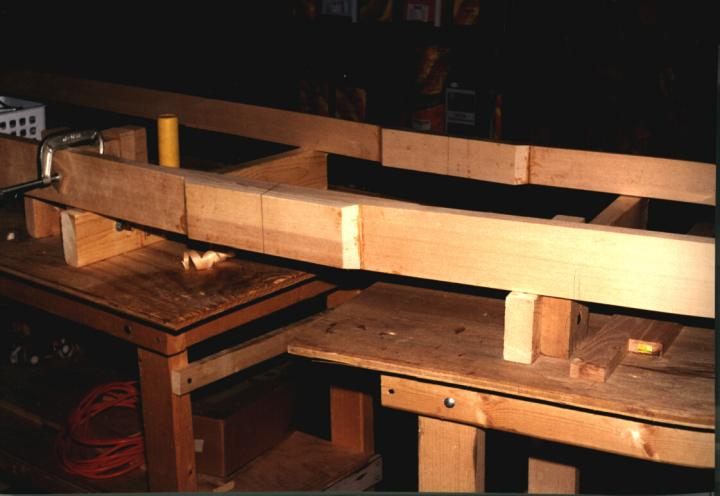
There are several processes to building the spars, especially the top
wing spars, before you get
to setting up the tables as you see in the above photo.
The spars are made from select spruce available from Aircraft
Spruce and Specialty near E. St. Louis, Illinois. Since the front
spar is located forward of the center of the wing it must be cut to match
the taper of the airfoil. To do this correctly you must set the angle
in a jointer before you cut the top and bottom of the spar. It's
important to make test cuts on a piece of scrap wood to prevent damaging
the expensive spar plank material. Making a prototype is always a
good idea. For example, as stated above, make your practice cuts
on a piece of scrap. This goes for the joint of the upper spar.
Make a prototype from scrap wood or just some pine that you get from the
lumber yard. There are a lot of problems that arise that you may
not think of in your mind and that the instruction do not discuss.
I was watching another practice that Brent always did when gluing pieces.
Every time he mixed a batch of T-88 Epoxy he made a test joint of wood
that he would later break to test the consistency of the glue. If
the glue broke and not the wood, he would have to go back and rebuild every
part that was made up using this batch of mixed glue. Luckily, we
never had a bad batch.
Throughout this photo series you will see that we are wearing coats
which meant that it was cold in the room where we were building the wing.
I want to assure you that what you see in the pictures where we were wearing
the coats was just preliminary setup and practicing the moves we were going
to use once the temperature was up to at least 70 degrees F.
All of the actual gluing must be done at 70 degrees or above and remain
at this temperature until the glue (epoxy cement) dries.